Why Every Business Needs the AIQ Framework
Feb 06, 2026
Everywhere you look, businesses are using AI. New tools. New pilots. New dashboards. The energy is real, but the breakthroughs everyone hoped for haven’t happened. Productivity gains have leveled out, and the excitement is wearing thin.
That’s not a tool problem. It’s a people problem. We learned how to use AI like a task master, giving it orders and checking the output. What we haven’t learned is how to work with it like a thought partner. The first wave was about getting faster. The next one will be about getting smarter. That takes curiosity, judgment and confidence. The edge now belongs to people who can make AI part of how they think, plan and solve problems.
That’s what the AIQ Framework(SM) helps you do. It turns AI from something that saves time into something that creates real value.
What’s the AIQ Framework
AIQ stands for Artificial Intelligence Quotient. It’s a way to understand how well you and your team work with AI. It looks at how clearly you ask for what you need, how well you judge what comes back and how you use those insights to make smarter decisions.
The AIQ Framework is a roadmap for building that skill. It helps people grow their fluency step by step through four dimensions that build on each other. Each one strengthens a different part of the relationship between people and AI. Together, they help teams move from using AI for quick answers to working with it as a trusted collaborator.
The Four Dimensions of the AIQ Framework
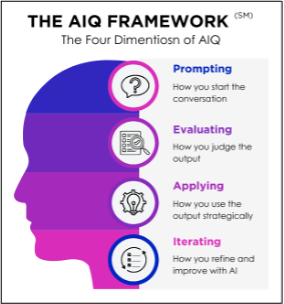
1. Prompting: How you start the conversation
Every great AI exchange starts with a clear ask. You already know this from working with people. If you give fuzzy direction, you get fuzzy results. It’s the same with AI. The way you frame the question shapes everything that comes next.
Strong prompting starts with context. You explain what you need, why it matters and what success looks like. When you do that, AI can zero in on what’s relevant instead of spinning its wheels. Maybe you’re analyzing a client’s cash flow. You could ask, “What do you see in these numbers?” and get something vague. Or you could ask, “Look at this client’s cash flow for the last three quarters and identify patterns that could affect liquidity next quarter.” The second prompt gives you insight. The first gives you filler.
Good prompting takes practice. It’s not about magic words. The better you get at prompting, the faster you get to value.
2. Evaluating: How you judge the output
Can you tell if AI’s answer is good, useful, biased or flat-out wrong? That’s the real test. Anyone can generate information. The skill is knowing when to trust it and when to question it.
Evaluation is where your professional judgment matters most. You slow down, check the logic and see if the result aligns with experience. You notice what’s missing. You make sure the story holds together. It’s the same discipline you use in accounting work.
3. Applying: How you use the output strategically
This is where AI starts to deliver real value. You take what it gives you and put it to work.
Maybe AI highlights that a client’s operating expenses are rising faster than revenue. You pair that with what you know about their hiring plans, vendor contracts and upcoming projects. Then you start a new conversation about efficiency or pricing. That’s applying. It’s turning information into insight and insight into strategy.
People with high AIQ make that leap naturally. They don’t just accept the output. They use it as a springboard for better questions, smarter plans, and stronger results.
4. Iterating: How you refine and improve with AI
Working with AI is a loop. You ask, you look, you adjust. Each round teaches you something new about how to guide it.
Think about training a new staff member. The first draft you received isn’t quite right. You review it, give feedback and see improvement the next time. AI works the same way. You tell it what worked, what missed and what you want more of. The next version gets closer to what you need.
Where the Rubber Meets the Road
The AIQ Framework helps people use AI with confidence. It focuses on asking better questions and making better decisions. It creates a learning culture where teams test ideas, share what works and keep improving together. And it connects people and technology in ways that make results stronger and more reliable.
When that happens, every project becomes a chance to learn. Every conversation becomes an opportunity to grow. That’s when AI stops being an experiment and starts becoming an advantage.
Humans Make the Difference
The return on AI depends on people. The tools can process the data, but people bring judgment, curiosity and connection. When you put those together, the results go further. Teams start using technology to move faster and think deeper.
That’s what makes AIQ a true growth strategy. Investing in people’s ability to work with AI strengthens every other effort you’ve made in technology, data and process. In an AI-first world, your edge isn’t access to tools. It’s how your people use them.
The future belongs to those who flex their AIQ.
Try It for Yourself
Ready to take it for a spin? Pick one process or one client project. Practice the four dimensions. Ask better questions. Evaluate what comes back. Apply the insight. Refine and repeat.
That’s AIQ in action. With each cycle, you’ll build fluency and confidence.
You can also take the AIQ Assessment to see your strengths and where you can grow. The more you practice thinking with AI, the more naturally it becomes part of how you lead.