How Tax Professionals Can Turn Bank Statements into a Quick P&L
Jun 03, 2026
By Jody Padar, XcelLabs
You know the client. They hand you a stack of bank statements at tax time and call it their records. No bookkeeping. No reconciled financials. Just months of raw transaction activity that someone now has to sort, categorize and organize before the actual tax work can even begin.
It happens every busy season. And for a lot of tax professionals, that cleanup process takes up far more time and mental energy than it should. The return itself is often fairly straightforward. It’s the reconstruction that drains you.
The firms gaining leverage right now are finding a faster path from those bank statements to usable numbers. That means less time buried in cleanup and more time for the work that actually grows the practice. Here’s how they’re doing it.
Why Cleanup Has Gotten Harder
The challenge today goes beyond bookkeeping habits. Small business finances are simply more fragmented than they used to be. A decade ago, most clients had a checking account and a credit card. Today, revenue might flow through Stripe, PayPal, Shopify, Square and Venmo. Expenses run through several cards, subscriptions, apps and payment platforms. Even a client with a few hundred thousand dollars in revenue can generate a surprising amount of transaction activity across a surprising number of sources.
That means you’re not just getting one bank statement anymore. You’re getting a stack of them, plus credit card exports, plus whatever else they managed to pull together before the deadline. Someone still has to work through all of it, figure out what’s income, what’s an owner’s draw, what’s a transfer and what belongs in each expense category. And all of that happens before the return even starts.
This is the bottleneck. And it’s exactly where there’s an opportunity to work differently.
What a Better Workflow Looks Like
The firms handling this best are not eliminating the cleanup process entirely. They’re just getting through it faster.
Instead of starting from zero and manually coding everything line by line, they’re finding ways to organize the activity quickly and generate a first-pass P&L so they can get into the actual accounting and tax work sooner.
That changes how busy season feels. Instead of spending hours building the first draft, your team can spend more time reviewing the numbers, correcting exceptions and advising clients.
That’s a much better use of talent than manually sorting transactions all day.
Where AI Can Help
This is exactly where AI can help. A lot of cleanup work is repetitive. The same transaction patterns tend to show up over and over again. That’s exactly the kind of pattern-recognition work AI is built for.
That becomes especially useful when you’re dealing wit
- Clients who only provide bank statements
- Catch-up bookkeeping tied to a return deadline
- Quarterly estimate work requiring current numbers
- Smaller clients who don’t have monthly bookkeeping support
- Last-minute engagements where there’s no time to start from zero
So, what does a faster cleanup process actually look like?
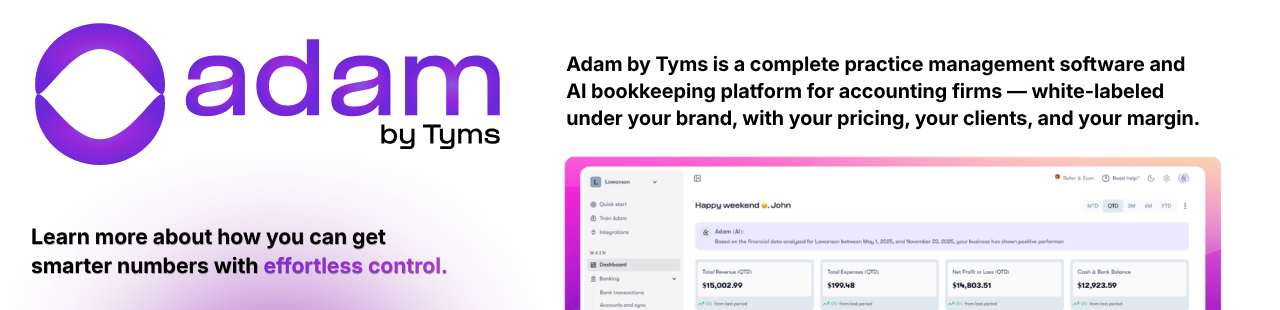
Platforms like Adam by Tyms are designed to help firms shorten the path from bank statements to a usable starting point for tax prep. You upload bank statements or transaction exports and it generates a draft P&L in minutes. Firms can also manage multiple clients and team workflows from a centralized dashboard, making it easier to scale this process across engagements.
Instead of manually building the books from scratch, you can start with organized numbers and focus your time on the actual accounting and tax work. There will always be transactions that need your eyes for a second look. But even reducing part of the reconstruction process can create meaningful time savings during busy season.
Curious? See Adam in action here.
The Opportunity for Firms
What would you do with more capacity during busy season?
For smaller firms and lean teams, reducing even part of the cleanup process can make a real difference. Less time spent organizing transactions means more room to take on additional work and fewer situations where a relatively simple return turns into hours of unpaid cleanup.
It also changes how experienced professionals spend their time. Instead of sorting transactions and cleaning up books all day, they can spend more time reviewing issues, answering client questions and helping businesses think ahead before filing deadlines hit.
And honestly, that’s where a lot of firms want to go. More planning conversations. More advisory work. More opportunities to strengthen the client relationship instead of simply organizing records.
Try It for Yourself
If cleanup work is eating into too much of your busy season, Adam by Tyms is worth a look. It’s a new solution that is still evolving, and it’s designed for exactly the kind of reconstruction work tax professionals already deal with every year. And generating a quick P&L is just one part of what the platform can do.
Schedule a demo to see how firms are using Adam to reduce cleanup work and move from bank statements to usable numbers faster.